
 ES
ES CA
CA EN
ENSEO for local businesses
SEO for local businesses
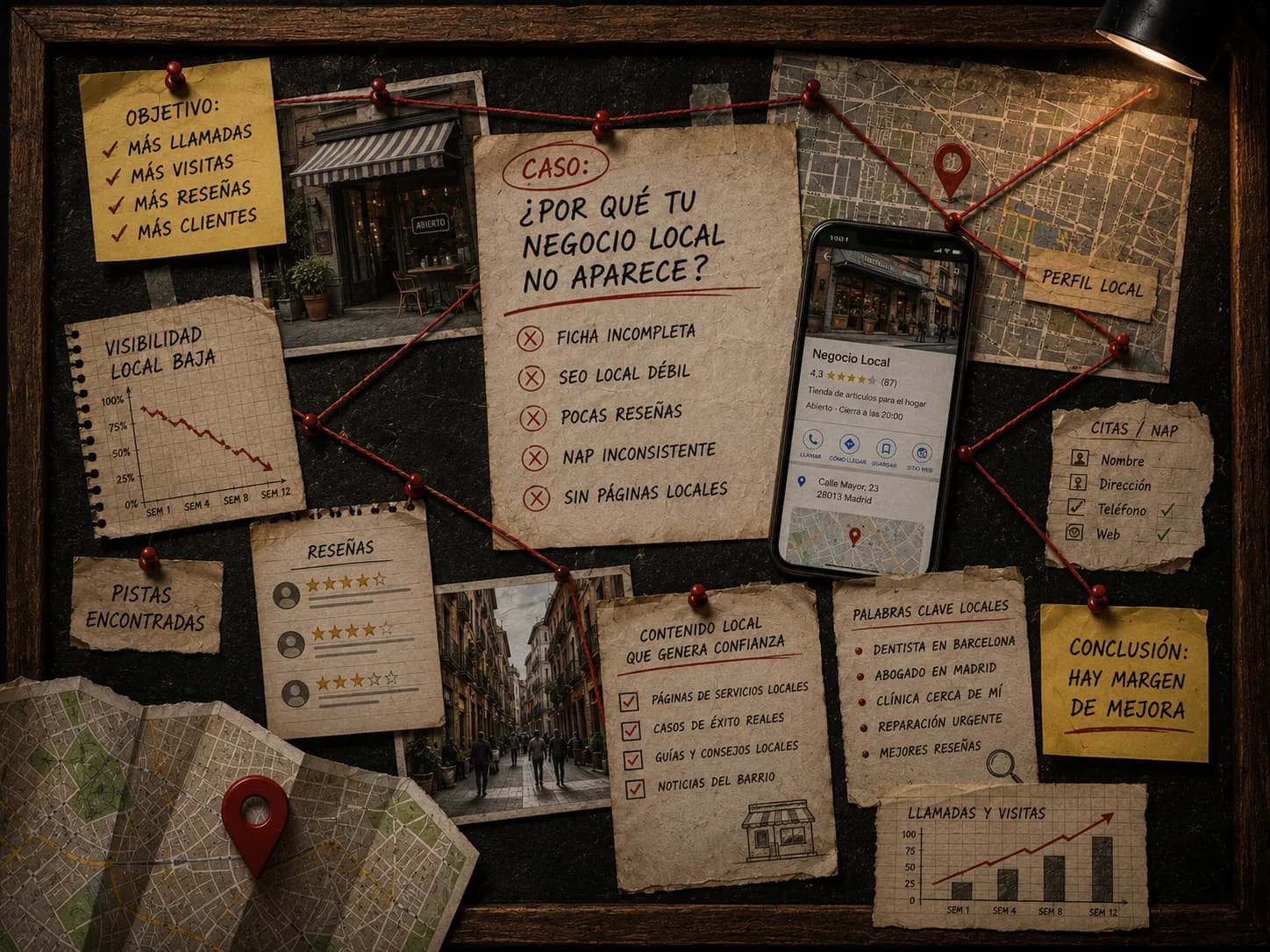
For local businesses, visibility doesn't depend on the website alone. The Google Business Profile, reviews, proximity and the consistency of the business data can influence results as much as the page's own content.
The strategy should help the business appear when a user searches for a nearby service, compares options on Google Maps or needs to get in touch quickly by call, WhatsApp or form.
- Google Business Profile and website working together
- Reviews and proximity reputation
- Service and location pages with real criteria
- “Near me” searches and Google Maps
- Fast contact by call, WhatsApp or booking
Proximity and urgency
In local SEO, proximity, trust and urgency matter
- A Google Business Profile can weigh as much as the website
- Many searches carry an immediate intent
- The decision is made comparing maps, reviews, photos, hours, services and ease of contact
- Conversion tends to be fast: a call, WhatsApp, booking or instant request
- Maps and the website work together
A Google Business Profile can be as decisive as the website: users often compare and get in touch without ever visiting it.
- Reputation drives the click
Reviews, photos and ratings influence which business gets the call, even before prices or services are compared.
- Geographic signals matter
Proximity, data consistency and the real service area affect when and where the business appears.
- Conversion has to be simple
The decision is usually quick: a call, WhatsApp, directions or a booking. Friction at the contact point costs customers.
Google profile
The Google profile can be a central piece of local acquisition
Google Business Profile
- Primary and secondary category
- Services
- Description
- Photos
- Reviews
- Hours
- Questions and answers
- Posts when they add value
- Consistency with the website
- Correct link to the site
- Service areas when relevant
Working the profile well doesn't mean promising visibility on Google Maps or a specific position: the goal is for the information to be complete, coherent and useful to anyone comparing options.
Services and locations
The website should organise services and locations with real criteria
Every URL should answer a specific intent. Location pages only make sense when there's a real branch or service area and original content, not a repeated template.
- Type 01
Service page
Explains a specific service, who it's for and how to hire it. Answers the search for the service, regardless of location.
- Type 02
Location page
Represents a real branch or service area, with its own information (address, hours, contact and context), not a repeated template.
- Type 03
Service + location
Combines both only when there is distinct demand, a real offer in that area and original content that justifies the URL.
Artificial or near-identical local pages should not be created for every neighbourhood or city just by swapping the area name. Those doorway pages add little for the user, dilute relevance and can harm the project.
One example of a real, published location page is our SEO agency in Horta-Guinardó, built on real data and services from a specific area.
Local trust
Reviews and local consistency are part of the strategy
- Consistent NAP (name, address and phone)
- Real reviews
- Business photos
- Correct categories
- Visible services
- Clear contact details
- Up-to-date hours
- Coherent presence across relevant directories and platforms
- Local associations, media mentions and partnerships
Reviews and mentions must be real: they're never bought, invented or incentivised deceptively. NAP consistency and business data across the website, profile and directories matter as much as the content itself.
Near me
Many local conversions start on Google Maps
Local search behaviour has its own traits:
- “Near me” searches
- Searches with a city, neighbourhood or area
- High-urgency queries
- Mobile-dominant behaviour
- Clicks to call, directions, WhatsApp or booking
Not all local searches include the city explicitly: Google can infer proximity intent from location and the service being searched for.
When speeding up immediate acquisition matters, organic work can be complemented with Google Ads management, a service limited to search campaigns and local advertising visible on Google Maps.
AI engines
Local information must be clear, coherent and verifiable
Local GEO helps search engines and assistants understand, based on visible information:
- What the business does
- Where it is
- Which areas it serves
- What services it offers
- How to get in touch
- What hours it operates
- What trust signals exist
Good practices
- Coherent NAP across website, profile and listings
- Clearly defined services
- Service areas explained without spam
- Useful service pages
- Information visible in HTML
- Consistent entity across website, profile and listings
Neither SEO nor GEO can guarantee that a business will appear in a specific answer, map or recommendation. The work consists of making the information clear, coherent and verifiable.
Contacts, not just visits
Local conversion tends to be measured more by contacts than by traffic
What can be measured
- Calls
- WhatsApp clicks
- Forms
- Bookings
- Requests
- Clicks on directions
- Interactions with the profile
- Leads by service or location
An interaction doesn't always equal a real customer: the data should be checked against what actually happens in the business to know which contacts turn into customers.
Local case research
How we approach an SEO strategy for a local business
- Understand services, location and the real acquisition area
- Review the Google Business Profile
- Research local searches and demand by service
- Organise the services and locations architecture
- Improve local trust and authority signals
- Measure contacts and adjust
This strategy can be executed through a monthly SEO service that combines analysis, implementation and ongoing improvement.
Real cases
Experience with real SEO projects
On the case studies page we gather SEO projects from different sectors and contexts, including businesses with very specific commercial and acquisition needs.
Strategy lead
Strategy direction
The strategy is led by Albert Juera, senior SEO and GEO specialist, who works on organic and AI engine positioning for both in-house and client projects.
Albert JueraLocal case questions
Frequently asked questions about SEO for local businesses
What matters more, the website or the Google Business Profile?
It depends on the search and the business: they don't compete, they complement each other. The Business Profile tends to be key for queries with immediate intent and map comparisons; the website sustains service information, trust and conversion. The effective approach is to work on both coherently, with the same data.
Is it worth creating a page for every city or neighbourhood?
Only when there is a real branch or service area, distinct demand and original content that adds value. Creating near-identical pages per neighbourhood or city, changing only the area name, is a doorway pages practice that adds little and can harm the project.
How do reviews influence local SEO?
They're part of the reputation and user experience, and they influence which business gets the click and the contact. They're handled with ethical processes: they should never be bought, invented or incentivised deceptively, and it's worth responding to them thoughtfully. They don't guarantee a specific map position.
Does local SEO work if I serve several areas?
Yes, as long as each area corresponds to real service coverage. The strategy distinguishes services from locations and only creates area pages when there's genuine offer and original content, avoiding duplicating the same information across many areas with no real differences.
What conversions are usually measured for a local business?
Calls, WhatsApp clicks, forms, bookings, requests, clicks on directions and interactions with the profile, plus leads by service or location. It's worth remembering that an interaction doesn't always equal a real customer, so the data should be checked against what actually happens in the business.
How long does it take to see results from local SEO?
We don't give a fixed timeframe. It depends on the starting point, competition in the area, the state of the Business Profile, reviews, the website and demand for each service. Local SEO and GEO are ongoing processes, not a one-off action.
Open a case
Want to improve your business's local visibility?
Tell us what service you offer, where you operate and how your contacts reach you today. We'll review whether SEO and GEO can help you capture more local opportunities with a realistic strategy.