
 ES
ES CA
CA EN
ENSEO for events and entertainment
SEO for events and entertainment
In events and entertainment, demand can spike within days and vanish just as fast. The strategy needs to balance speed, timeliness and evergreen content, without losing editorial clarity or technical control.
SEO and AI search visibility should help artists, events, films, characters, games, shows or competitions get found at the right moment, with an architecture able to capture trends without depending on them alone.
- Entities: artists, events, titles and competitions
- Evergreen and trend content coexisting
- Agile publishing to capture spikes
- Visual content that supports the indexable website
- Use of materials with clear rights
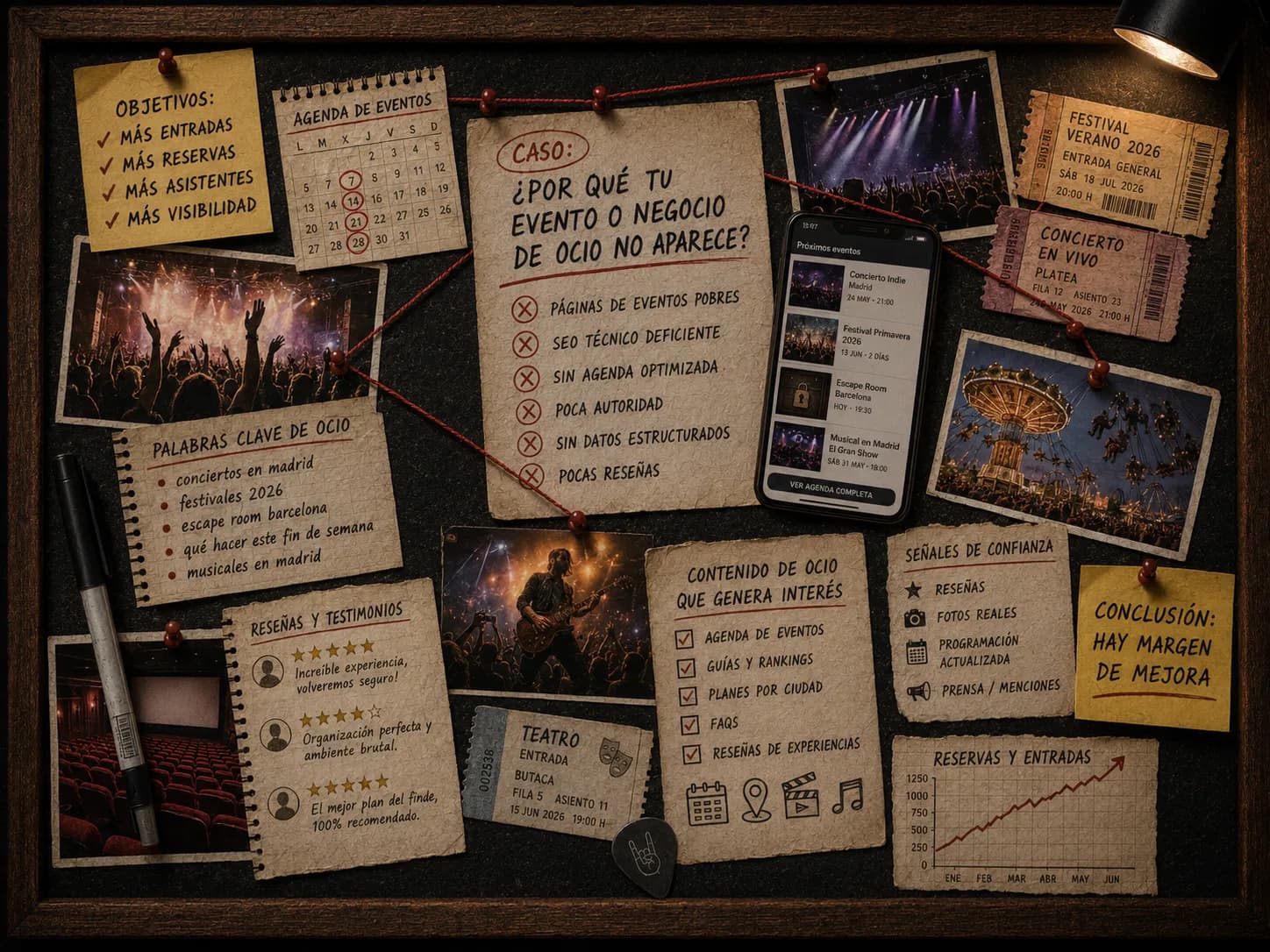
Speed and shifting demand
In entertainment, speed and shifting demand can be decisive
- Publishing speed can be critical
- Many URLs and pieces of content lose value quickly
- Some searches grow explosively
- Competition can come from media outlets, giant platforms and social networks
- Speed
The window of opportunity can last just days: publishing or updating on time can matter as much as the content itself.
- Timeliness
Releases, dates, announcements and results constantly shift demand and force you to keep information up to date.
- Entities
Artists, events, titles and competitions are the backbone: search engines and AI need to understand and relate them.
- Evergreen foundation
Capturing trends shouldn't come at the expense of the stable pages that sustain authority and traffic over time.
Sector entities
The strategy revolves around artists, events, titles and competitions
Entity types
- Artists
- Events
- Festivals
- Films
- TV shows
- Characters
- Games
- Competitions
- Venues or locations
Content should help search engines and AI systems understand, for each entity:
- What the entity is
- How it relates to others
- When it happens
- Where it happens
- Why it's relevant
Two publishing rhythms
Not everything should be published the same way
Sustains authority and more stable traffic over time:
- Guides
- Profiles
- Category pages
- Bios
- Explainers
- Resources
Captures demand spikes as they arise:
- News
- Dates
- Releases
- Announcements
- Changes
- Results
- Viral moments
Both approaches need to coexist: evergreen content sustains authority and more stable traffic, while trend content captures demand spikes. Neither replaces the other.
Agile publishing
Capitalising on a trend demands agile publishing processes
- Spot topics quickly
- Create or update pages on time
- Avoid publishing late on short-lived searches
- Review headlines, snippets, links and visible dates
- Update when key data changes
Being first helps, but it doesn't guarantee rankings: speed is an advantage, not a promise of ranking.
To accompany very short-lived demand spikes, organic work can be complemented with Google Ads management, a service limited to search campaigns and local advertising on Google Maps.
Content map
Pages need to organise events, entities and formats without chaos
- Event pages
- Artist or entity profiles
- Film, show, game or performance pages
- Thematic categories
- Agendas or calendars
- Evergreen resources
- News or updates
- Don't create mass URLs without a distinct search intent
- Don't duplicate pages for near-identical variations
- Avoid cannibalisation between news, profiles and categories
The weight of visuals
Visual content carries more weight than in many other sectors
Video, images and social media carry a lot of weight in how this sector is consumed and discovered, but they don't replace an indexable website. We don't invent galleries or audiovisual materials that don't exist.
- The website must keep useful indexable content
- It shouldn't rely solely on external platforms
- Visual content should support understanding of the entity or event
Rights and licences
The strategy must respect copyright and licensing
Materials that are usually protected
- Promotional images
- Videos
- Lyrics
- Cover art
- Posters
- Audiovisual material
- Screenshots
- Third-party assets
- Not everything circulating on social media can be reused.
- It's best to work with owned, licensed or clearly rights-cleared materials.
- SEO never justifies infringing copyright.
We don't recommend copying full lyrics, official posters or protected material without permission. Reusing third-party assets without a licence is a legal risk, not an SEO tactic.
AI engines
Information needs to be clear, updatable and easy to relate
GEO helps search engines and assistants understand, based on visible information:
- What entity it is
- What happens
- When
- Where
- For whom
- In what format
- How it relates to other entities
- What data is verified
Best practices
- Well-defined entities
- Clear dates
- Visible locations
- Up-to-date content
- Relationships between artist, event, venue and category
- Useful FAQs
- Authorship and context signals
Neither SEO nor GEO can guarantee that content will appear in a specific answer, nor capture every trend. The work is about making information clear, updatable and easy to relate.
Impact and volatility
Performance can vary a lot depending on the content type
What can be measured
- Clicks
- Sessions
- Pageviews
- Reaction time to trends
- Leads or form submissions
- Ticket sales, where applicable
- Sign-ups
- Subscriptions
- Visits to event pages
- Growth of evergreen pages versus spikes in timely content
What to keep in mind
- Not every traffic spike generates business.
- Some content is useful for visibility or indirect acquisition.
- Demand can be highly volatile.
Editorial case research
How we approach an SEO strategy for events and entertainment
- Understand the project type, audiences and calendar
- Map entities and topics
- Distinguish evergreen content from trend content
- Organise the architecture and internal linking
- Work on fast publishing, updates and visual context
- Measure impact and adjust
This strategy can be executed through a monthly SEO service combining analysis, implementation and continuous improvement.
Real case files
Experience with real SEO projects
On the case studies page we bring together SEO projects across different sectors and business models, focused on contexts where organic acquisition demands a careful editorial and technical strategy.
Strategy lead
Strategy direction
The strategy is led by Albert Juera, consultor seo y geo, who works on organic and AI search visibility for both his own projects and clients.
Albert JueraCase file questions
Frequently asked questions about SEO for events and entertainment
Does it make sense to work on SEO in a sector where many searches are short-lived?
Yes, as long as two layers are combined: capturing demand spikes with timely content and sustaining authority with evergreen pages. Betting only on the ephemeral leaves the project without a base; betting only on the stable wastes the trends. Balance is what delivers sustainable results.
How do you combine evergreen content and trend content?
Evergreen content (guides, profiles, categories, bios) sustains steady traffic and authority; trend content (news, dates, releases, results) captures the spikes. They're linked together so a timely spike reinforces the foundation pages, and those pages give context to the news.
Which pages matter most in an events or entertainment project?
It depends on the project, but event pages and entity profiles (artist, title, competition) tend to be key, supported by agendas or calendars and evergreen resources. Priority is decided by demand, intent and acquisition goals, not sheer volume.
How much do video and images influence the strategy?
A great deal, because much of this sector's consumption and discovery is visual. Even so, the website must keep useful indexable content and not rely solely on external platforms: visual material supports understanding of the entity or event, but doesn't replace a solid architecture.
What copyright risks exist in this sector?
Many: promotional images, videos, lyrics, cover art, posters, screenshots and other third-party assets are usually protected. Not everything circulating on social media can be reused. It's best to work with owned, licensed or clearly rights-cleared materials; SEO never justifies infringing copyright.
How is SEO success measured when demand shifts so much?
By combining visibility metrics (clicks, sessions, pageviews, reaction time to trends) with conversions where they exist (leads, sign-ups, ticket sales where applicable) and watching how the evergreen foundation grows against timely spikes. Not every traffic spike generates business, so the data is read in context.
How long does it take to see results from an SEO strategy in entertainment?
We don't give a fixed timeframe. Trend content can react quickly, but authority and the evergreen foundation are built over time, and demand in this sector is highly variable. SEO and GEO are ongoing processes, even more so when they depend on current events.
Open an investigation
Want to improve the visibility of your events or entertainment project?
Tell us what kind of project you run, how it depends on current events, and which content or entities matter most for your acquisition. We'll review whether SEO and GEO can help with a realistic strategy.